Aging Is Not One Pathway.

Modern aging research does not point to a single biological switch. A widely cited scientific framework describes 12 interconnected hallmarks of aging: genomic instability, telomere attrition, epigenetic alterations, loss of proteostasis, disabled macroautophagy, deregulated nutrient sensing, mitochondrial dysfunction, cellular senescence, stem cell exhaustion, altered intercellular communication, chronic inflammation and dysbiosis.

These processes influence one another. Changes in one system can affect how others maintain energy, respond to stress and preserve normal cellular function over time.

López-Otín C, et al. Hallmarks of aging: An expanding universe. Cell, 2023. Read the study →

Interconnected aging biology networkA central hub labeled Interconnected Aging Biology connects to twelve surrounding nodes: Genomic Instability, Telomere Attrition, Epigenetic Alterations, Loss of Proteostasis, Disabled Autophagy, Nutrient Sensing, Mitochondrial Dysfunction, Cellular Senescence, Stem Cell Exhaustion, Intercellular Communication, Chronic Inflammation and Dysbiosis. Subtle links between surrounding nodes indicate that these systems can influence one another.INTERCONNECTEDAGINGBIOLOGYGenomicInstabilityTelomereAttritionEpigeneticAlterationsLoss ofProteostasisDisabledAutophagyNutrientSensingMitochondrialDysfunctionCellularSenescenceStem CellExhaustionIntercellularCommunicationChronicInflammationDysbiosisInterconnected aging biology networkA central hub labeled Interconnected Aging Biology connects to twelve nodes arranged in two columns: Genomic Instability, Telomere Attrition, Epigenetic Alterations, Loss of Proteostasis, Disabled Autophagy, Nutrient Sensing, Mitochondrial Dysfunction, Cellular Senescence, Stem Cell Exhaustion, Intercellular Communication, Chronic Inflammation and Dysbiosis. Subtle links between surrounding nodes indicate that these systems can influence one another.INTERCONNECTEDAGINGBIOLOGYGenomicInstabilityTelomereAttritionEpigeneticAlterationsLoss ofProteostasisDisabledAutophagyNutrientSensingMitochondrialDysfunctionCellularSenescenceStem CellExhaustionIntercellularCommunicationChronicInflammationDysbiosis

Why Flex Takes a Multi-Pathway Approach

Flex was formulated with 10 ingredients studied individually in relation to several biological systems discussed in healthy-aging research, including cellular energy metabolism, mitochondrial function, nutrient sensing, stress response and inflammatory signaling.

These are a few of the many studies behind Flex's ingredients. For each one: the dose tested, and where the evidence falls short.

SINGLE-PATHWAY APPROACH

Cellular Energy
Mitochondrial Function
Nutrient Sensing
Stress Response
Inflammatory Signaling

Organized around one primary biological system.

FLEX’S APPROACH

Cellular Energy
Mitochondrial Function
Nutrient Sensing
Stress Response
Inflammatory Signaling

Ten ingredients selected across multiple research areas.

Explore some of the ingredient research

Read peer-reviewed studies on individual ingredients in Flex, organized by research area.

Nicotinamide Riboside

NR Raised NAD+ Within Two Weeks

Study overview

Cells rely on a small helper molecule to process fuel and support normal energy metabolism. That molecule is NAD+. In this eight-week randomized, double-blind trial, 140 otherwise healthy adults with overweight received placebo or 100, 300, or 1,000 mg of NIAGEN® daily. Whole-blood NAD+ rose by 22%, 51%, and 142%, respectively, within two weeks, with no significant difference in adverse events versus placebo.

Change in whole-blood NAD+ after two weeks
  • 100 mg +22%
  • 300 mg +51%

    NR per serving in Flex

  • 1,000 mg +142%
  1. NR
  2. helps produce NAD+
  3. supports normal cellular energy metabolism*

Conze, D., Brenner, C., & Kruger, C. L. (2019). “Safety and Metabolism of Long-term Administration of NIAGEN (Nicotinamide Riboside Chloride) in a Randomized, Double-Blind, Placebo-controlled Clinical Trial of Healthy Overweight Adults.” Scientific Reports, 9, 9772.

Read the study

Nicotinamide Riboside

NR and Fatigue Resistance

Study overview

100 finishing animals (barrows) received 0, 15, 30, or 45 mg/kg of NR daily for 11 days before a controlled performance test.

Results

  • Certain NR groups traveled farther or exercised longer than controls.
  • Researchers also observed differences in muscle recruitment, lactate accumulation, and mitochondrial DNA expression.

Connection to energy

NAD+ participates in mitochondrial ATP production. This study explored whether NR’s role as an NAD+ precursor could influence physical fatigue resistance.

Hennesy, H. M., et al. (2024). “Ability of Nicotinamide Riboside to Prevent Muscle Fatigue of Barrows Subjected to a Performance Test.” Metabolites, 14(8), 424.

Read the study

VITAMIN D3

Vitamin D3 and Exercise Performance

2,000 IU
Daily
12 weeks
Study duration
46 participants
Active young men

Study design

This randomized, double-blind, placebo-controlled trial followed 46 active young men who received either 2,000 IU of vitamin D3 daily or placebo for 12 weeks.

What the study found

  • The vitamin D3 group had higher vitamin D levels, VO₂max, and average power—and a lower Wingate fatigue index—than the placebo group.
  • Peak power did not change.
  • The fatigue index was an exercise-performance measurement, not a measure of self-reported tiredness.

Dose in Flex

Flex contains 2,000 IU of vitamin D3 per serving, matching the studied daily dose.

Study scope

The study tested vitamin D3 alone, not Flex.

Ramezani Ahmadi, A., et al. (2020). “Effects of vitamin D3 supplementation for 12 weeks on serum levels of anabolic hormones, anaerobic power, and aerobic performance in active male subjects: A randomized, double-blind, placebo-controlled trial.” European Journal of Sport Science, 20(10), 1355–1367.

Read the study

VITAMIN D3 · DEFICIENCY-SPECIFIC STUDY

Vitamin D3 and Self-Perceived Fatigue

100,000 IU
One-time oral dose
4 weeks
Follow-up
120 participants
Adults with fatigue and low vitamin D

Study design

This randomized, double-blind, placebo-controlled trial followed 120 otherwise healthy adults experiencing fatigue with vitamin D levels below 20 ng/mL. Their average age was 29, 53% were women, and participants received either a one-time oral dose of 100,000 IU vitamin D3 or placebo.

What the study found

  • Fatigue scores decreased by 3.3 points with vitamin D3 versus 0.8 points with placebo.
  • 72% of the vitamin D3 group reported improvement versus 50% of the placebo group.

Conflict disclosure

The authors reported no conflicts of interest.

Nowak, A., Boesch, L., Andres, E., et al. (2016). “Effect of vitamin D3 on self-perceived fatigue: A double-blind randomized placebo-controlled trial.” Medicine, 95(52), e5353.

Read the study

L-THEANINE

L-Theanine Supported Faster Attention After One Dose

Study overview

A randomized, double-blind, placebo-controlled study of adults ages 50–69.

Results

A single dose produced faster Stroop-task reaction time, more correct working-memory responses, and fewer omission errors.

Connection to focus

The measured outcomes relate directly to attention, accuracy, and working memory.

Baba, Y., Inagaki, S., Nakagawa, S., et al. (2021). “Effects of L-Theanine on Cognitive Function in Middle-Aged and Older Subjects: A Randomized Placebo-Controlled Study.” Journal of Medicinal Food, 24(4), 333–341.

Read the study

L-THEANINE

L-Theanine Supported a Relaxed, Alert Brain State

Study overview

Healthy young adults received either 50 mg of L-theanine or placebo while researchers measured brain activity using EEG.

Results

L-theanine produced a greater increase in alpha-wave activity between 45 and 105 minutes after ingestion.

Connection to focus

Alpha activity is associated with a relaxed but wakeful mental state.

Dose connection

Flex provides 50 mg of L-theanine per serving, matching the amount evaluated in this study.

Nobre, A. C., Rao, A., & Owen, G. N. (2008). “L-theanine, a natural constituent in tea, and its effect on mental state.” Asia Pacific Journal of Clinical Nutrition, 17(Suppl 1), 167–168.

Read the study

GOTU KOLA

Gotu Kola Supported Working Memory and Alertness

Study overview

In this randomized, double-blind, placebo-controlled study, 28 healthy older adults received placebo or 250, 500, or 750 mg of Gotu Kola extract once daily for eight weeks.

What researchers measured

Researchers measured cognitive performance with computerized tests and assessed mood using visual analogue scales.

Results

The clearest working-memory findings occurred in the 750 mg group, with improvements in self-rated mood also reported.

Wattanathorn, J., Mator, L., Muchimapura, S., et al. (2008). “Positive modulation of cognition and mood in the healthy elderly volunteer following the administration of Centella asiatica.” Journal of Ethnopharmacology, 116(2), 325–332.

Read the study

HOLY BASIL · TULSI

Tulsi Improved Reaction Time and Accuracy

Study overview

This randomized, double-blind, placebo-controlled trial enrolled 44 healthy men ages 18–30. Participants received either placebo or 300 mg daily of a 70% ethanolic Tulsi leaf extract for 30 days. Four participants did not complete the trial, leaving 40 in the reported analysis.

What researchers measured

Two tests, both measuring how your brain performs under a bit of mental pressure. The Sternberg test is a quick memory check — you memorize a short list, then say whether a new item was on it, and researchers track how fast and accurately you answer. The Stroop test is a focus check with two versions: an easier one where the ink color and the word don’t conflict, and a harder one where a color word is printed in a mismatched ink (like the word ‘red’ printed in blue) which is a classic way to test how well your brain can concentrate through distraction.

Results

Compared with placebo, the Tulsi group had faster reaction times and fewer mistakes on the Sternberg memory test. On the Stroop test, Tulsi improved reaction time on the easier version, and improved both speed and accuracy on the harder version.

Sampath, S., Mahapatra, S. C., Padhi, M. M., Sharma, R., & Talwar, A. (2015). “Holy basil (Ocimum sanctum Linn.) leaf extract enhances specific cognitive parameters in healthy adult volunteers: A placebo controlled study.” Indian Journal of Physiology and Pharmacology, 59(1), 69–77.

Read the study

ASTRAGALOSIDES

Muscle Strength Returned Two Days Earlier

4 mg
Daily
7 days
Recovery period
11 participants
Recreationally active young men

Study design

This randomized, double-blind, placebo-controlled crossover study followed 11 recreationally active young men. After researchers induced muscle damage in one leg with eccentric knee-extension exercise, each participant completed seven days of recovery with 4 mg total astragalosides daily and seven days with placebo in separate study periods.

What the study found

  • Knee-extension strength returned to baseline on day 5 with astragalosides and day 7 with placebo.
  • Creatine kinase and myoglobin were lower on days 1–3, while lactate dehydrogenase was lower on days 2–3, compared with placebo.
Return to baseline muscle strength
Astragalosides Day 5 Strength returned to baseline
Placebo Day 7 Strength returned to baseline

Dose and compound disclosure

Astragalosides are the active compounds in astragalus root. Astragaloside IV — widely regarded as the most bioactive of the four — is the specific compound used in Flex, at 3 mg per serving. The study above tested 4 mg daily of a broader astragalosides blend.

Yeh, T.-S., Lei, T.-H., Barnes, M. J., & Zhang, L. (2022). “Astragalosides Supplementation Enhances Intrinsic Muscle Repair Capacity Following Eccentric Exercise-Induced Injury.” Nutrients, 14(20), 4339.

Read the study

ASTRAGALUS ROOT EXTRACT

Astragalus Supported Post-Exercise Immune Response

Study design

This randomized, double-blind, placebo-controlled trial followed 18 young male members of the Polish National Rowing Team during a six-week training camp. Participants received placebo or two 500 mg capsules of Astragalus membranaceus root extract daily.

What researchers measured

Researchers measured selected cytokines before and after a maximal 2,000-meter rowing test and again after 24 hours of recovery. After six weeks, the Astragalus group showed a different post-exercise IL-2 response and a higher recovery-phase IL-2/IL-10 response than placebo.

RESULTS

  • Helped the immune system stay balanced through weeks of intense training, instead of wearing down like it normally would.
  • Supported a faster return to balance in the 24 hours after hard exercise.

POST-EXERCISE RECOVERY

IL-2 Higher during recovery
IL-2/IL-10 ratio Higher during recovery

Dose and extract disclosure

The trial used 1,000 mg daily of an Astragalus root extract, compared to 500 mg Flex Astragalus root extract.

Latour, E., Arlet, J., Latour, E. E., et al. (2021). “Standardized astragalus extract for attenuation of the immunosuppression induced by strenuous physical exercise: randomized controlled trial.” Journal of the International Society of Sports Nutrition, 18, 57.

Read the study

PINE BARK EXTRACT

Pine Bark Extract Lowered an Oxidative-Stress Marker

100 mg
Daily
8 weeks
Training program
147 completers
Healthy adults

Study design

This was the 100 mg portion of an open, controlled product-registry study using Pycnogenol® during an eight-week Army Physical Fitness Test training program. Of the healthy adults who completed the program, 74 used Pycnogenol and 73 served as comparable controls; both groups followed structured training.

What the study found

Researchers measured plasma free radicals at baseline and after eight weeks. The marker decreased in men and women taking Pycnogenol and increased in male and female controls, with a statistically significant difference between groups.

OXIDATIVE-STRESS MARKER AFTER EIGHT WEEKS

Pine bark group Lower than baseline
Control group Higher than baseline

Ingredient-source disclosure

The study tested 100 mg Pycnogenol®, a branded French maritime pine-bark extract. Flex provides 100 mg of pine bark OPCs per serving from a different pine bark source.

Vinciguerra, G., Belcaro, G., Bonanni, E., et al. (2013). “Evaluation of the effects of supplementation with Pycnogenol® on fitness in normal subjects with the Army Physical Fitness Test and in performances of athletes in the 100-minute triathlon.” Journal of Sports Medicine and Physical Fitness, 53(6), 644–654.

Read the study
Dr. Bryant Villeponteau, PhD molecular biologist

The Formulator

Dr. Bryant Villeponteau

Senior scientist who led the team that cloned the RNA component of human telomerase at Geron Corporation. 30+ years in longevity research.

Dr. Villeponteau has spent over a decade formulating multi-pathway botanical blends targeting this mechanism. Flex is his updated formulation — refined ingredients, optimized for adults in their 30s and 40s who want to get ahead of decline, not catch up to it.

From Early Research to Flex

Flex began with a question Dr. Bryant Villeponteau had been investigating for years: could a combination of ingredients support multiple biological pathways at the same time?

Testing the Multi-Pathway Idea

In 2015, Dr. Villeponteau and his collaborators published a peer-reviewed PLOS ONE study evaluating an earlier four-ingredient botanical blend in fruit flies.

Under high-stress experimental conditions, treatment with a supplement containing astragalus, vaccinium extract, pine bark OPCs, and L-theanine, resulted in:

  • Approximately double the maximum lifespan among the longest-lived flies
  • A 49% increase in mean lifespan when supplementation began early in life
  • A 27% increase in mean lifespan when supplementation began at midlife
  • A 62% increase in median survival during partial-starvation stress

The results were highly dependent on the testing environment. Lifespan effects were substantially reduced or absent under lower-stress laboratory conditions.

Fruit flies are useful for studying conserved biological pathways, but results in fruit flies may not predict outcomes in people. Three out of the four of the ingredients used in this study are in Guva Flex.

Read the published PLOS ONE study →

Moving Into Human Research

The next step was a small, IRB-approved human pilot study published in 2017. Fifteen adults, with a mean age of 57, took a related 10-ingredient botanical formula for 15 weeks.

Researchers observed the following effects:

  • Supports Cardiovascular Health
  • Peak lung expiratory flow increased by 16.6%
  • The study’s HRV-derived stress measure decreased by 24.8%

These pre-to-post changes reached statistical significance in the study. However, it was a small, open-label trial without a placebo group. Seven out of ten of the ingredients in the formula tested are used in Guva Flex.

Read the published human pilot study →

The Evolution to Flex

These early studies helped shape Dr. Villeponteau’s multi-pathway formulation philosophy: cellular health is influenced by interconnected systems, so a comprehensive formula should be designed with more than one biological pathway in mind.

Flex is a later, distinct formulation. It combines 10 disclosed ingredients selected from contemporary research related to cellular energy, focus, stress response and recovery.

Third-Party Testing

Tested for Purity. Independently Verified.

Flex is third-party tested for heavy metals and microbial contaminants by ISO/IEC 17025:2017 accredited laboratories. The certificate of analysis covers the finished product — Lot# 6060283 — not just individual ingredients.

View Certificate of Analysis →

ARL Analytical Resource Laboratories · Swift Laboratory · ISO/IEC 17025:2017 Accredited

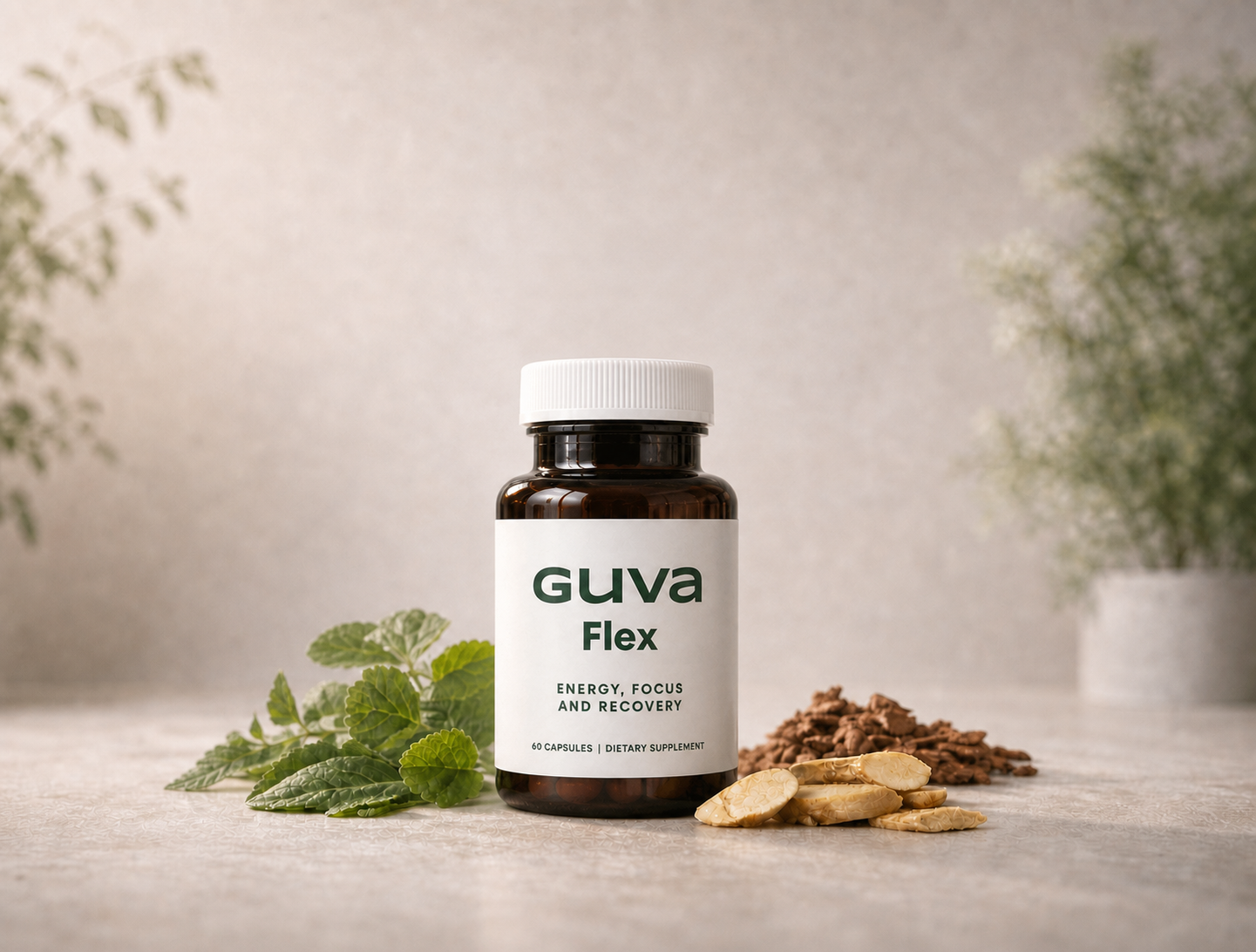
Flex daily cellular support supplement bottle

GUVA FLEX

A Multi-Pathway Approach, in One Daily Formula.

Flex brings together 10 disclosed ingredients selected from research related to cellular energy, clear focus, stress response and recovery.

10 disclosed ingredients · Stimulant-free

Shop Flex